
The Role of Phosphate in Agriculture and Global Food Production
Phosphorus is an essential plant nutrient involved in energy transfer, root establishment, crop development and seed formation. Effective phosphate nutrition, however, requires more than applying a fertilizer: the source, rate, timing, placement, soil condition and crop requirement must be evaluated together.
Why phosphorus matters throughout the crop cycle.
Plants need phosphorus in smaller quantities than nitrogen, but inadequate phosphorus availability can restrict crop development. The effect of an application depends on whether phosphorus becomes available in the root zone when the crop needs it.
Early Crop Establishment
Phosphorus supports early root development and the establishment of young plants, particularly where soil phosphorus supply is limited.
Plant Energy Processes
Phosphorus is part of the biological systems that store and transfer energy during photosynthesis, respiration and growth.
Flowering and Seed Formation
Adequate phosphorus nutrition contributes to reproductive development, seed formation and crop maturity.
Efficient Land Use
Correct nutrient management can help crops use soil, water and other nutrients more effectively within a balanced program.
The phosphorus supply chain must connect geology with agronomy.
Phosphate rock is the principal mineral resource used to manufacture phosphate fertilizers. Agricultural performance is determined not only by the original rock grade, but also by processing, fertilizer form, soil reaction, application method and crop demand.
Mineral source evaluated by P₂O₅, chemistry, reactivity, impurities, form and particle size.
Material may be sized, granulated or processed into different phosphate fertilizer products.
The source is chosen according to soil, crop, nutrient concentration and application system.
Phosphorus release and retention are affected by soil pH, minerals, moisture, placement and biology.
Roots absorb dissolved phosphate from the soil solution during the crop cycle.
Why the same phosphate source can perform differently between fields.
Phosphorus availability is highly dependent on local conditions. Responsible recommendations should consider soil testing, crop demand, expected nutrient removal and the behavior of the selected phosphate source.
| Factor | Why It Matters | Buyer or Agronomist Question |
|---|---|---|
| Soil pH | Soil acidity or alkalinity influences phosphorus reactions, retention and availability. | What is the current soil pH and amendment program? |
| Soil test phosphorus | Indicates whether additional phosphorus is likely to be required and supports rate planning. | Which soil-test method and interpretation are used locally? |
| Phosphate source | Water-soluble fertilizers and natural phosphate rock behave differently after application. | Does the selected source match the soil and production system? |
| Particle size | Particle size can influence handling, distribution and the interaction of natural phosphate with soil. | Is the required size or granulation clearly specified? |
| Placement | Placement affects root access and contact between phosphorus, soil and water. | Will the fertilizer be broadcast, banded or placed by another method? |
| Moisture and root growth | Phosphorus moves only short distances in soil, making root-zone conditions important. | Does the crop have adequate moisture and root-zone development? |
| Crop and yield target | Different crops and production targets have different phosphorus demand and removal levels. | What crop, expected yield and nutrient-removal plan apply? |
Different phosphate products serve different agricultural needs.
Buyers should compare nutrient analysis, solubility, product form, particle size, sulfur contribution, packing, distribution system and local agronomic recommendations before selecting a product.
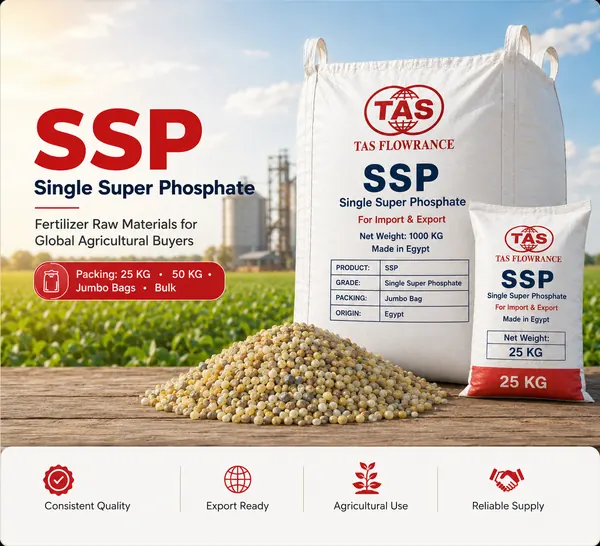
Single Super Phosphate — SSP
SSP is a phosphate fertilizer route relevant to agricultural distributors and nutrient programs requiring phosphate together with associated sulfur and calcium components, subject to the current product analysis.
Final nutrient content, granulation, moisture and packing should be confirmed through the current COA and quotation.
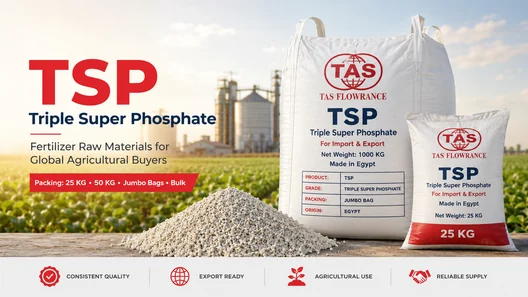
Triple Super Phosphate — TSP
TSP is a more concentrated phosphate fertilizer route for buyers requiring a higher phosphorus concentration per unit of product than lower-analysis phosphate fertilizers.
Product selection should consider the guaranteed analysis, granule size, handling system, crop plan and local fertilizer rules.
Use the right source, rate, time and place.
Responsible phosphate use should support crop productivity, nutrient-use efficiency and water-quality protection. The correct strategy is field-specific rather than product-only.
Right Source
Select a phosphate source whose nutrient form, concentration and physical properties match the soil, crop and application method.
Right Rate
Base the rate on soil testing, realistic yield targets, crop demand, nutrient removal and existing phosphorus supply.
Right Time
Coordinate application with crop demand, field access, soil conditions and the behavior of the selected source.
Right Place
Position phosphorus where roots can access it while reducing avoidable surface losses and contact with runoff pathways.
Both phosphorus deficiency and unnecessary surplus create risk.
| Situation | Potential Agronomic Effect | Recommended Response |
|---|---|---|
| Low plant-available phosphorus | Restricted early growth, weak root establishment, delayed development or reduced yield potential may occur. | Confirm deficiency through soil or plant analysis and use an agronomically suitable phosphate source. |
| Incorrect product selection | Nutrient-release behavior or product form may not match the field, crop or application equipment. | Compare analysis, solubility, particle size, handling and agronomic suitability. |
| Excessive phosphorus accumulation | Additional fertilizer may provide limited crop benefit while increasing economic and environmental risk. | Use soil-test trends and nutrient budgets to prevent repeated unnecessary application. |
| Surface loss and erosion | Dissolved or sediment-bound phosphorus may move from the field to surface water. | Manage placement, timing, erosion, runoff and high-risk application areas. |
Information required before selecting or importing a phosphate product.
Technical and agronomic information
- Required product: rock phosphate, granular phosphate, SSP or TSP.
- Target P₂O₅ or guaranteed nutrient analysis.
- Required sulfur, calcium or other nutrient contribution.
- Granular size, powder size or physical-form requirement.
- Soil type, soil pH and intended crop program.
- Direct agricultural use or fertilizer manufacturing use.
- Required COA, sample and inspection arrangements.
Commercial and logistics information
- Trial quantity or metric tons per shipment.
- Monthly, seasonal or annual demand.
- Bulk, jumbo bags, 50 kg or other packing.
- Destination country and destination port.
- Preferred FOB, CFR or CIF quotation basis.
- Target shipment date and delivery program.
- Import, labelling and documentation requirements.
Egyptian Rock Phosphate Technical Data Sheet
Review the TAS Flowrance technical reference covering phosphate grades, chemical parameters, particle-size considerations, quality-control guidance, available forms and export RFQ information.
Continue your phosphate and fertilizer review.
Further reading from recognized agricultural organizations.
These external resources support the scientific and nutrient-management principles explained on this page.
Send your phosphate or fertilizer requirement.
Provide complete product, technical and destination details so the TAS Flowrance team can review the relevant supply route.
Submit your agricultural product inquiry
Frequently asked questions about phosphate in agriculture.
Why do crops need phosphorus?
Is phosphate rock the same as phosphate fertilizer?
Can rock phosphate be applied directly to every soil?
What is the difference between SSP and TSP?
What information is required for a quotation?
Can TAS Flowrance provide a field application rate?
Looking for an Egyptian phosphate product for agriculture?
Send the product name, required analysis, quantity, packing, destination port and intended application. Our export team will review the relevant product and commercial supply route.